B2B BUYER’S GUIDE
PC Power Supply Quality Inspection: An Acceptance Plan for Importers
A useful PSU inspection report identifies the exact model, test conditions, measured scope and lot decision. A pass sticker alone cannot answer those questions.
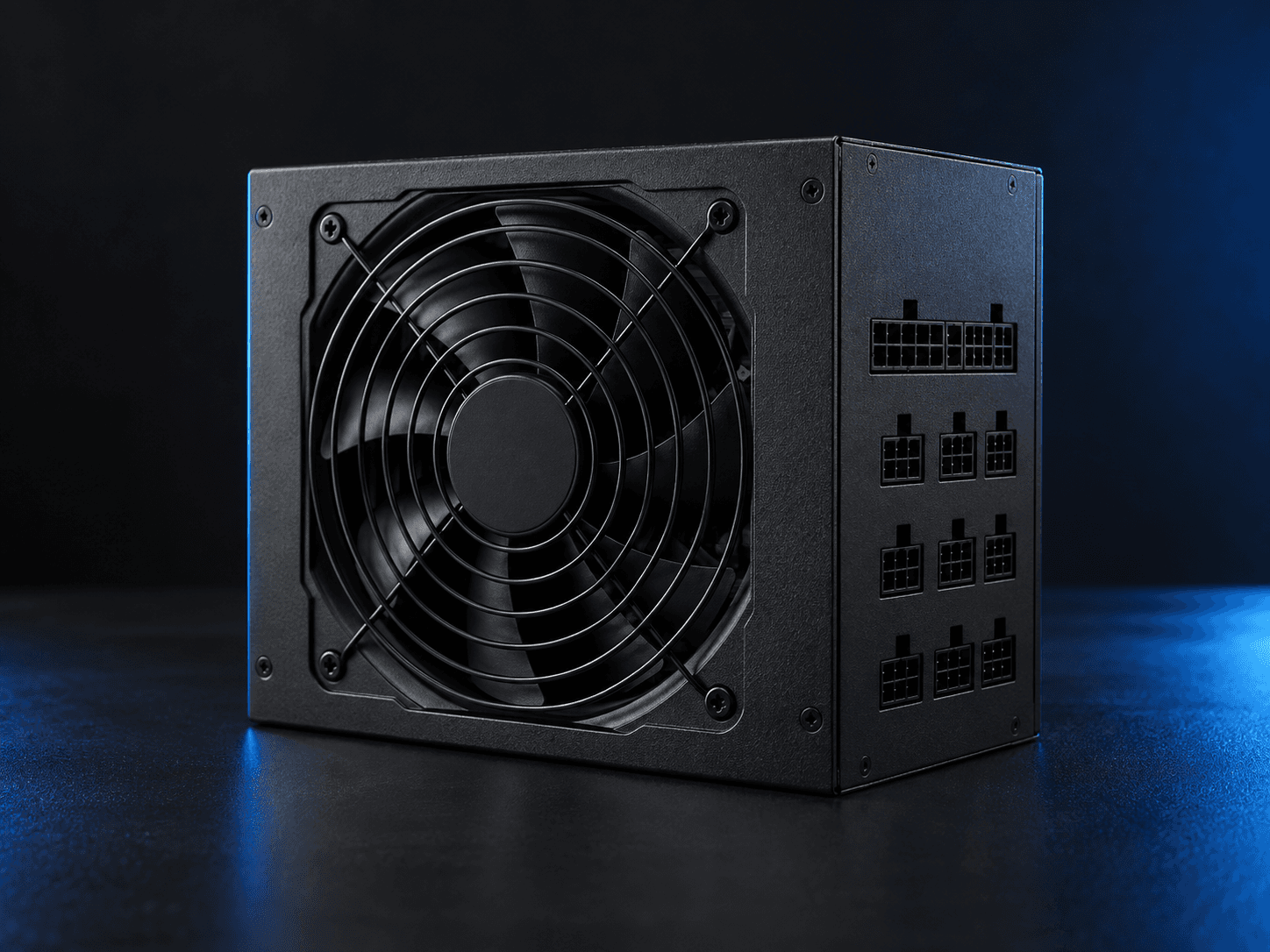
Editorial illustration. Not a photograph of an actual Hekut test or shipment.
Introduction: agree what the inspection result means
A PC power supply inspection should tell a buyer whether the quoted model and delivered lot meet clearly defined requirements. It should identify the PSU, cable kit, test scope, conditions and acceptance decision. A report that merely says passed may hide whether the supplier checked appearance, ran a simple output screen or completed a more extensive electrical evaluation. Those activities have different purposes and should not share an unexplained label.
For importers and system integrators, the first step is to separate design qualification, production screening and shipment acceptance. Design evidence concerns the model and revision. Production checks concern repeatable manufacture. Shipment inspection concerns conformity of the lot that will be delivered. This guide explains how to connect them in a practical acceptance plan. It does not present a particular Hekut PSU as certified or laboratory-tested without model-specific documentation.
Define the model and order configuration precisely
Record the exact PSU part number, hardware revision, rated output, form factor and claimed design-guide revision. Identify the approved label, AC input specification, cable kit, regional cord and packaging. A generic family name is not enough when wattage, connectors or included accessories vary within the range. If private labeling is requested, preserve the underlying model identity so technical reports can still be matched to the supplied product.
The purchase specification should distinguish mandatory requirements from preferences. Connector count, suitable output capacity and destination documentation may be mandatory, while cable finish or carton appearance may be commercial choices. Define which changes require buyer approval, including revisions that affect cables, fan behavior, internal platform or test coverage. Use the power supply sourcing page to start a discussion, then put the exact released configuration into the quotation and order.
Request an evidence package before the shipment is ready
Ask the supplier for a sample report format early enough to resolve ambiguity. The package should state which checks apply to every unit, which use a shipment sample and which refer to engineering qualification. Request the procedure revision, conditions, instrument or station identity where relevant, results and disposition. Match any external report to the exact model and stated scope rather than treating an unrelated certificate as proof of conformity.
An illustrative buyer might require universal identity and cable-content checks, a defined production electrical screen and a separately agreed pre-shipment sample. That is an example of layered evidence, not a universal test prescription. The right coverage depends on program risk, volume, supplier controls and contractual requirements. Put the selected coverage in writing so the quoted price and inspection expectation describe the same service.
Agree how the supplier records rework and retest. If a unit fails, is repaired and passes, the final report should retain the original finding and disposition at the required level of traceability. A clean final pass count without context may be insufficient for the buyer's analysis. Decide what data must accompany the shipment and what supporting records must remain available if a later issue arises.
| Evidence layer | Typical purpose | Buyer question |
|---|---|---|
| Model qualification | Evaluate the selected design and revision | Does the report apply to this exact PSU? |
| Production screening | Control repeatable output and assembly | What is checked, at what coverage and with which limits? |
| Shipment inspection | Assess the released lot against the order | How was the lot defined and sampled? |
| System validation | Check PSU integration in the finished PC | Does the approved configuration operate as required? |
| Traceability | Support containment and service | Can a finding be related to the supplied units? |
Inspect exterior condition, markings and connection hardware
Check the housing for dents, loose parts, damaged fasteners, obstructed ventilation and obvious assembly defects. Confirm that the output label and product identity match the order and remain legible. Record any inconsistency between the label, cable list and quotation rather than resolving it by assumption. A wattage claim on the carton does not override the model specification.
Examine connector housings, retention features and visible contacts for damage or contamination. Verify the supplied cable assemblies against the approved kit, including connector count and usable length where specified. Check that CPU, graphics and peripheral cables are correctly identified for the supplied PSU. Modular PSU-side interfaces are not universal; Corsair's official cable chart illustrates why family and model confirmation matter.
Do not open a PSU for an informal internal inspection. Any internal examination or energized electrical work belongs to appropriately qualified personnel following suitable procedures. For a buyer's exterior shipment check, define what can be observed without dismantling the unit and how suspect units are held. An unfamiliar mark or component appearance should lead to a documented question, not an unsupported safety conclusion.
Interpret electrical tests by their actual scope
Ask what an output-voltage result represents. A no-load screen, a basic tester and an electronic-load measurement under defined conditions do not establish the same things. A meaningful report identifies load arrangement, input conditions, measurement points and acceptance limits. If several output rails or combined limits matter, the procedure should explain how those conditions are exercised.
Ripple, transient response, startup timing and protection behavior require suitable methods and equipment. A simple tester cannot substitute for all of them. Intel's conventional multi-rail ATX guidance includes requirements and a framework for power excursions; the supplier should identify the revision and scope behind its claim. Do not copy isolated numerical limits into an inspection checklist without understanding the measurement method and applicability.
For a purchasing team, the practical task is not to recreate a PSU laboratory from a short article. It is to ask precise questions and obtain evidence from a capable source. If a report lacks conditions or claims a broad conclusion from a narrow measurement, request clarification or a suitable additional evaluation. Keep the accepted scope visible so downstream sales material does not exaggerate what was established.
Check efficiency and safety documentation separately
If the quotation claims an 80 PLUS efficiency level, verify the exact model and applicable report using the program's official resources. Record which model was assessed and whether that identity matches the offered product. Efficiency documentation concerns stated performance under its test conditions; it should not be used as a substitute for every other electrical, mechanical or service requirement.
Safety and destination-market documentation also need a model and scope check. Ask the importer or responsible compliance specialist what the actual order requires, then request suitable documents from the supplier. Verify that the issuer, product identity and applicable scope are consistent. Do not assume that an efficiency badge establishes market authorization or that a general factory management certificate establishes the safety assessment of this PSU.
Keep the document review practical. A table connecting each required claim with its supporting record and reviewer can reveal gaps before packing begins. If an item is not applicable, document why. If a requested document belongs to another model or an obsolete revision, resolve that mismatch before approval rather than attaching it to make the file appear complete.
Evaluate thermal and fan behavior under defined conditions
Record the operating environment and mounting orientation used for any thermal or acoustic assessment. The intended enclosure, intake route and workload can affect behavior. An open-bench observation should be identified as such rather than presented as proof of operation inside a restricted chassis. Ask what temperature rating or derating statement applies to the quoted model and how that relates to the customer application.
If a PSU includes a selectable or semi-passive fan mode, identify the mode used. A stationary fan at low load is not automatically a fault when the design supports that behavior, but the assembly team needs the correct expectations. Conversely, a fan that spins during a brief power-on does not establish satisfactory behavior throughout the working range.
Where acoustics matter, define an appropriate evaluation method and keep the enclosure, room conditions and load comparable between samples. Informal listening can help a buyer identify an objectionable sound, but it should not be reported as a calibrated noise measurement. Separate practical sample observations from formal laboratory data and give each the weight its method supports.
Run assembled-system validation for the purchased build
A power supply can match its specification and still be unsuitable for a particular integration. Validate the selected PSU and approved cable kit with the actual processor, graphics card, motherboard, drives and chassis. Check startup, restart, shutdown and relevant workload transitions. Record settings that affect power demand, including processor and graphics power policies, rather than describing the system only by its marketing class.
Inspect cable seating, routing, fan clearance and panel closure during the sample build. Follow the component manufacturers' cable instructions, especially where graphics power connections need specific arrangements. A missing connector or cramped route should be resolved before the configuration is released. Do not allow an unapproved adapter to become an undocumented part of the accepted sample.
If a fault occurs, preserve its conditions and isolate variables systematically. A shutdown is an observation, not a confirmed PSU root cause. Record whether it follows one graphics card, one cable kit, a particular workload or another component. Return to the full released configuration after diagnostic substitutions so the final evidence concerns the system the customer will receive.
Include installation preparation in the release record
Document the cable kit, required connection sequence and any access constraints created by the enclosure. Ask another trained assembler to follow the instruction on a pilot unit. Clarify points where the operator cannot see a latch, identify a cable or close a panel normally. This method review helps ensure that an electrically suitable sample can also be assembled consistently.
Set lot, sampling and defect rules before inspection
Define what constitutes the lot: model, revision, production interval and any grouping important to the buyer's control plan. Choose a documented sampling and acceptance method where sampling is used, and explain how samples are selected. Avoid treating a sample chosen for convenience as random. Record carton and serial identities so the observed results can be related to the shipment.
Classify findings by their agreed consequence and response. A wrong cable kit, damaged connector and minor cosmetic mark need not have the same disposition. Define rules for serious findings, repeated functional failures, mixed model identities and incomplete documentation. The supplier should know when the lot must be held and who can authorize screening, rework or another inspection.
A sampling decision does not prove that every untested unit is defect-free. Its usefulness comes from a defined method applied correctly and supported by production controls. If the buyer needs universal verification of a particular requirement, state that explicitly and assess feasibility. Keep sampling scope separate from any claim that every PSU received the same test.
Account for mixed revisions within an order
An order can contain more than one meaningful production grouping even when every carton carries the same commercial family name. Ask whether hardware revisions, cable kits or production intervals differ and decide which distinctions matter to acceptance. Where a change could affect the evidence, identify those groups in the inspection record instead of allowing a convenient sample from one group to represent another silently. The supplier should disclose the grouping before the inspector selects units.
Suppose the first part of an order uses the approved cable kit and the balance uses a proposed replacement kit. The inspection team should not average those configurations together and report one undifferentiated result. First establish whether the substitute is approved, then apply the agreed checks to the appropriate groups. If the revision change is only a label correction, document that limited scope and its supporting review. The objective is proportional control, not an unnecessary test repetition for every administrative change. Defining these boundaries helps the buyer make a defensible release decision, especially when a shipment is split across dates or destinations and receiving teams need to know which records apply to their cartons.
Keep nonconforming units and corrective actions traceable
Quarantine suspect units and record the original finding before any rework. Preserve their cable kits where compatibility or connector damage may be relevant. If returned units are mixed with unrelated accessories, an investigation can become much harder. Define whether the supplier requires the entire configuration or a controlled set of parts for assessment.
Reinspection should match the corrective action. Replacing a cable assembly calls for different checks from an internal design change, and a firmware-related issue in another system component should not be recorded as a PSU repair. Qualified technical personnel should determine appropriate electrical requalification when the unit itself is changed. The final disposition needs to identify what was done and which evidence supports release.
Use recurring findings to improve containment and future acceptance requirements. If the same accessory is missing repeatedly, an additional electrical stress test will not address the packing mechanism. If a reported fault appears only in a particular PC configuration, revisit system qualification. The corrective response should follow the evidence rather than adding unrelated checks simply to demonstrate activity.
Verify packing, records and the logistics handover
Confirm PSU, cable kit and AC cord contents against the released pack list. Inspect cushioning and connector protection, and ensure the unit cannot move in a way that damages its accessories. Verify that carton labels and electronic packing data correspond to the actual units. If serial information is required, compare a sample of the file against physical labels before handover.
Inspectors should record the state that logistics will receive. Repacking or cable substitution after inspection can invalidate parts of the report. Define who owns that step and whether it requires another check. For a complete-PC shipment, preserve the approved installed cable route and use packaging appropriate to the assembled system; a PSU component carton evaluation cannot establish the protection of an entire computer.
Hekut has an 8,000 m² factory in Shenzhen. Buyers can review factory information and send an inspection brief through the contact page or info@Hekut.com. Include the selected model, destination, quantities, acceptance scope and reporting requirements so specific capability and evidence can be confirmed before the order is released.
Frequently asked questions about PSU inspection
Is a basic PSU tester enough for quality acceptance?
It can support limited screening if used appropriately, but it does not establish every electrical requirement. Define what it measures and supplement it with the model qualification, production controls and system validation needed for the order. Do not report narrow screening as full design compliance.
Does an efficiency certificate prove a PSU is safe?
Efficiency and safety are different assessment scopes. Verify the exact efficiency claim using its official records, and review the destination and product-specific safety documentation separately. The buyer should understand what each document actually establishes.
Must every unit receive the same tests?
Coverage depends on the agreed control and acceptance plan. Some checks may be universal, others sampled and others part of model qualification. Make those distinctions explicit so the shipment report does not imply that every unit received a test performed only on an engineering sample.
How should a supplier report reworked PSUs?
Retain the original finding, corrective action, affected identity and relevant retest result at the agreed traceability level. An unexplained final pass mark can hide information the buyer needs to assess process stability or respond to a later return.
What should an importer send with a PSU quality inquiry?
Send exact model or feature requirements, system configuration, destination, quantities, required cable kit, documentation expectations and acceptance scope. Ask the supplier to identify confirmed capability, exceptions and tests needing additional arrangements. That creates a comparable and actionable quotation.
Conclusion: require evidence that supports the release decision
Useful PSU inspection connects the purchased configuration to defined checks and traceable results. It separates model qualification from production screening, confirms cable and document identity, and preserves the actual state delivered to logistics. The goal is a clear release decision that the buyer and supplier can explain using the same evidence.
Before approving the next shipment, review the proposed report against your real acceptance questions. Close gaps while the sample and quotation are still under discussion. Send Hekut your model requirements and inspection brief to agree a practical sourcing conversation, sample evaluation scope and documentation plan.